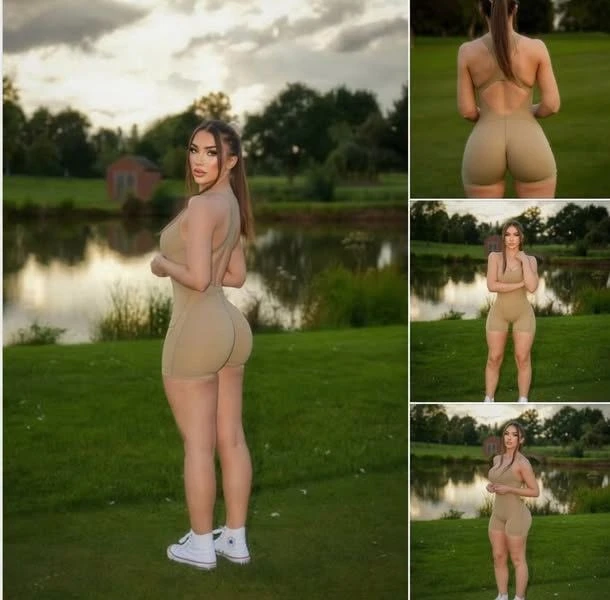
The separation between a woman’s legs does not tell you what kind of person she is, how attractive she is, how healthy she is, or what her personality is like. Yet this simple physical feature has often been surrounded by myths, assumptions, and exaggerated claims, especially on social media.
A headline suggesting that the space between a woman’s legs means she is “more” of something may attract attention, but the reality is much more interesting than a viral claim. Every human body is different.
The shape of a person’s legs depends on many factors, including bone structure, hip width, muscle development, body composition, posture, and genetics. Some women naturally have a noticeable space between their thighs when standing normally. Others have thighs that touch. Both are completely ordinary variations of the human body.
One of the most common misconceptions is that a visible gap between the thighs automatically indicates a particular body type or level of fitness. That is not necessarily true.
A woman who exercises regularly may have thighs that touch, while someone who does very little exercise may naturally have a gap because of her skeletal structure. Fitness cannot be accurately judged simply by looking at the space between someone’s legs.
The position of the hips and knees plays an important role as well. The angle of the femur, the width and shape of the pelvis, and the alignment of the legs can influence whether the thighs naturally meet.
These characteristics are largely determined by genetics and anatomy rather than by effort or lifestyle. Body composition can also influence appearance. Changes in muscle and body fat may alter the shape of the thighs, but there is no universal relationship between weight and the presence of a thigh gap.
Two women with the same height and weight can have completely different leg shapes. Another important point is that the appearance of the legs can change depending on posture.
Standing with the feet close together, standing with the feet apart, shifting body weight, or rotating the hips can all change how much space appears between the legs. Photographs can therefore create an impression that does not represent someone’s natural appearance. Social media has made this subject even more confusing.
Images are frequently photographed from carefully selected angles, enhanced with lighting, edited digitally, or presented alongside beauty standards designed to attract attention. When people repeatedly see one particular body shape online, they may begin to believe that it is the normal or ideal shape for everyone.
In reality, human bodies have enormous natural diversity. There is also a difference between attraction and health. A particular physical feature may be considered attractive by one person and unimportant to another. Personal preferences are different, but they should not be confused with scientific facts.
Having a thigh gap does not automatically make someone healthier, more feminine, more athletic, or more attractive.