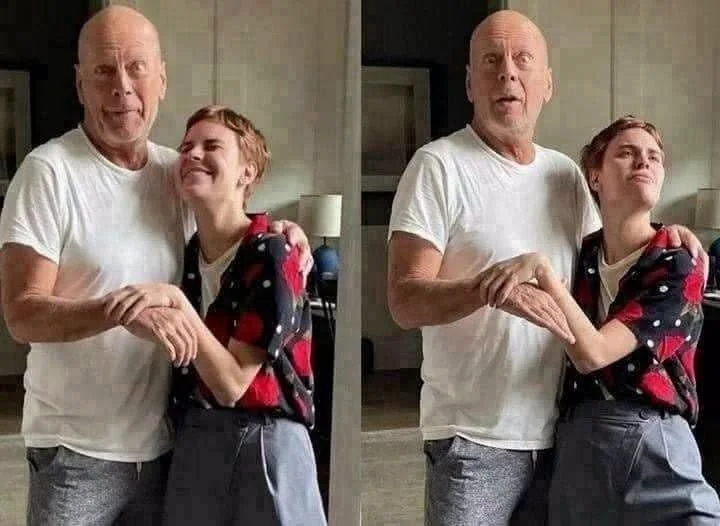
Bruce Willis Is No Longer Able to Communicate Verbally. Bruce Willis remains one of Hollywood’s most recognizable stars, but in recent years his life has changed dramatically because of frontotemporal dementia (FTD), a progressive neurological condition that has affected his ability to communicate.
The latest information from his family makes one thing clear: his language abilities have been seriously affected. However, it is important not to turn that difficult reality into an exaggerated headline.
His wife, Emma Heming Willis, explained in June 2026 that the particular form of FTD Bruce has primarily affects language, while she also clarified that it does not affect his memory in the same way people often assume.
For decades, audiences knew him as a quick-witted actor whose performances were built around dialogue, humor, confidence, and personality. Whether he was playing an action hero, a detective, a troubled father, or a comedic character, his voice was an important part of his identity as a performer.
Now, his family has had to adapt to a world in which spoken language is increasingly difficult for him. Emma previously explained that Bruce’s language was “going” and that the family had developed different ways of communicating with him.
She also said that he remained physically mobile and was otherwise in good health at that time. This distinction matters because losing the ability to speak easily does not necessarily mean losing the ability to understand, feel, recognize loved ones, or connect emotionally.
Frontotemporal dementia can affect different areas of the brain and can present differently from person to person. Emma explained in 2026 that there are different variants of FTD, with Bruce’s primarily affecting language. Other variants can affect behavior or movement.
That is why headlines suggesting that Bruce has simply “forgotten everything” can be misleading. His wife has specifically said that he still recognizes his family, including his five daughters. For his loved ones, this distinction is incredibly important. A person may struggle to find words while still understanding affection.
They may struggle to form sentences while still recognizing a familiar face. They may communicate through expressions, gestures, eye contact, touch, or other forms of interaction. Communication is much bigger than speech. Bruce’s family has increasingly emphasized connection rather than focusing only on what he can no longer do.
His daughter Rumer Willis has also spoken about her father and described him as “OK” within the reality of his diagnosis. She has discussed the tenderness she has noticed in him as the family continues adapting to his condition.
That perspective offers an important lesson for families dealing with neurological disease. A diagnosis can change someone’s abilities without erasing the person they have always been.