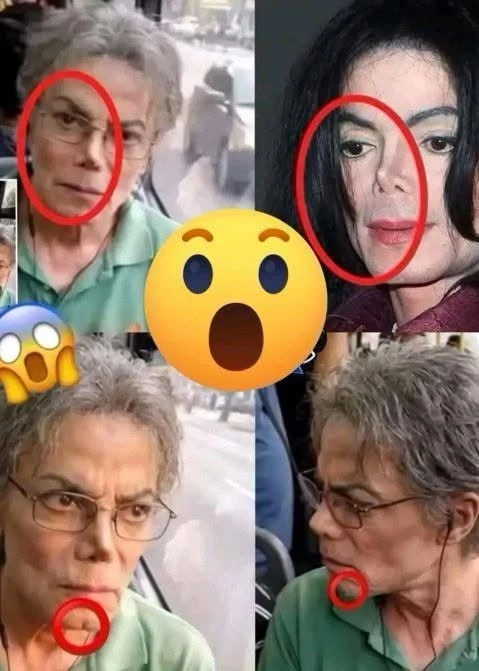
Every few years, the internet seems to discover a photograph that sends people into a frenzy. One blurry image appears online. Someone notices a familiar face. A caption makes a dramatic claim.
Within hours, thousands of people are sharing it, commenting on it, and asking the same question: “Could Michael Jackson really be alive?” A recent social-media post follows exactly that formula. It claims that a photograph shows a person on the street who looks remarkably similar to the late pop superstar.
The caption suggests that the image could be evidence that Michael Jackson survived his reported death in 2009. It is the kind of claim that immediately grabs attention. But there is a major difference between an intriguing resemblance and proof.
Michael Jackson died in June 2009 at the age of 50. His death was extensively documented, investigated, and reported around the world. There is no credible evidence establishing that he survived. So why do photographs like this continue to create such excitement?
The answer has a lot to do with Michael Jackson’s extraordinary cultural legacy. The Face Everyone Recognizes Michael Jackson had one of the most recognizable faces in modern entertainment. For decades, millions of people watched him perform on television, on concert stages, in music videos, and in photographs.
His appearance changed considerably throughout his life, but certain features remained familiar: his eyes, his distinctive expressions, his mannerisms, and the unmistakable way he carried himself. That makes it surprisingly easy for someone with similar features to attract attention. A photograph can also exaggerate a resemblance. Lighting changes facial features.
Camera angles change proportions. Shadows can make someone’s face appear narrower or more familiar. A low-resolution image can make the effect even stronger. Suddenly, an ordinary stranger can look remarkably similar to a famous person. The photograph itself might not be particularly convincing.
But then someone adds a caption: “Michael Jackson is alive.” That sentence changes the way people look at the picture. Instead of seeing an unidentified person, viewers begin searching for similarities. The hairstyle reminds them of Jackson. The posture looks familiar.
And because people naturally search for patterns, the resemblance can begin to feel stronger with every second of examination. This is an important psychological effect. When someone tells us what we are supposed to see, we often become more likely to notice evidence that supports the suggestion.
The photograph hasn’t changed. The Mystery of the Blurry Image There is another reason these rumors survive: poor image quality. A crystal-clear photograph makes identification easier. A blurry photograph does the opposite. When details disappear, the viewer’s brain fills in the gaps. A shadow might become a familiar cheekbone.