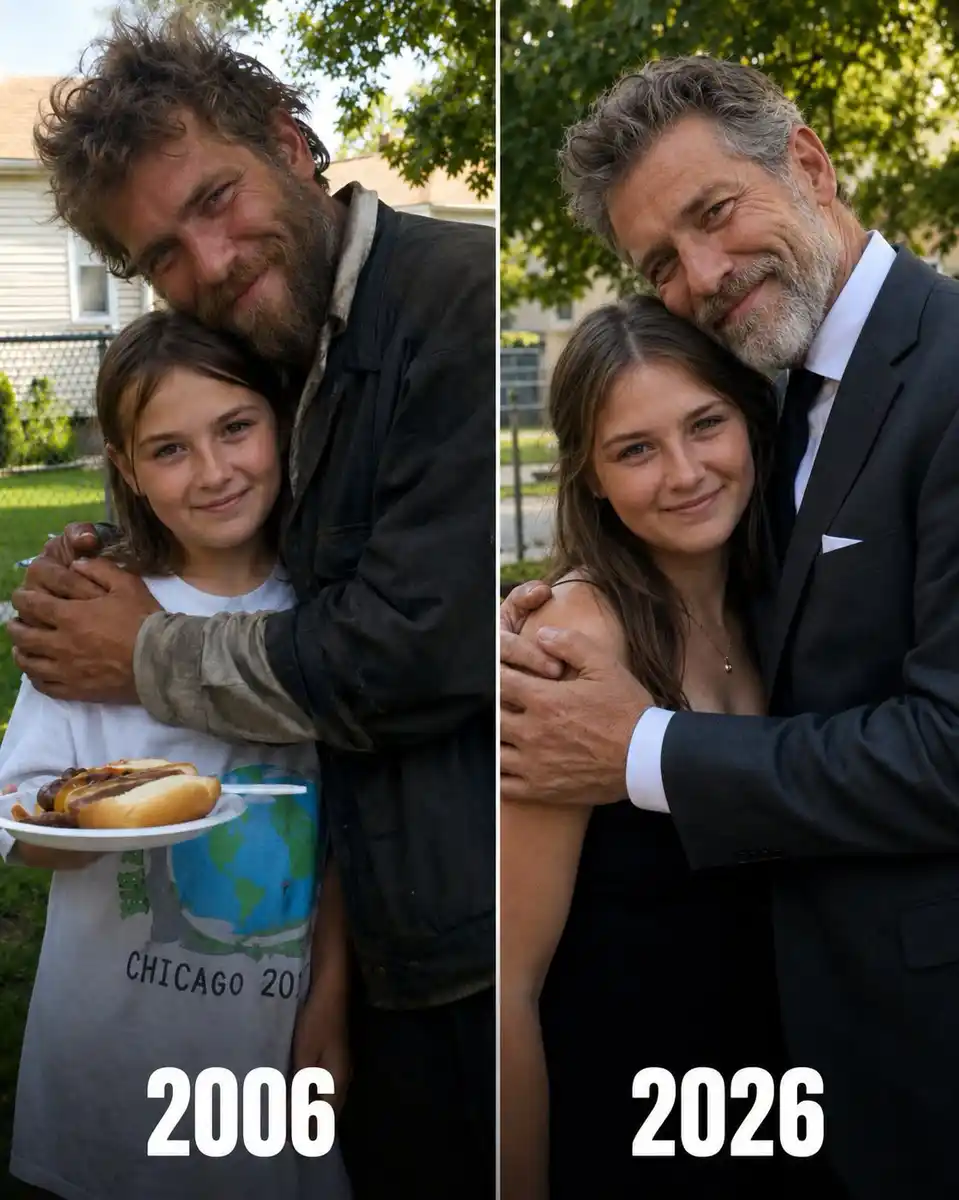
For twenty years, I believed my mother had chosen a homeless man over me. Even after she died, I continued bringing Victor food only because I had made her a promise. I thought it was the final burden she had placed on my shoulders.
Then Victor showed me the silver locket my mother claimed she had lost when I was eight, and everything I believed about him—and about my family—fell apart. The morning after my mother’s funeral, Victor’s shelter behind her house was empty.
For most of my childhood, he had lived near the back fence beneath a rough roof made from plastic tarps and pieces of discarded wood. No matter how little money we had, my mother prepared a meal for him every day.
That morning, I carried the beef stew she had begged me to bring him, expecting to find him wrapped in an old blanket near the fence. Instead, he stood beside a black SUV wearing a clean, dark coat. His tangled beard was gone.
Without it, he looked older and strangely familiar. But it was the object in his hand that made me stop breathing. My mother’s silver locket. The one she had sworn was lost decades ago. “I thought you might not come, Fiona,” Victor said. I nearly dropped the container.
His eyes were red, as though he had been crying. “What is happening?” I asked. “Whose car is that?
And where did you get my mother’s necklace?” Discover more Accessing Creative Writers Resources Enrolling In Online Psychology Courses Booking Historical Guided Tours He looked down at the locket, closing his fingers around it protectively.
“Before Stephanie died, she made me promise I would keep quiet.” Victor slowly lifted his gaze toward the kitchen window. It was the same window where my mother used to stand and watch him whenever she thought I wasn’t paying attention. My childhood had been defined by that kitchen.
Every afternoon, my mother packed three meals. Two remained on our chipped table—one for her and one for me. The third always went into a mismatched plastic container for Victor.
I hated watching her place the largest piece of chicken in his container when my shoes were held together with tape. The electricity had been shut off twice during one especially cold winter, yet Victor never missed lunch.
I was eleven when I finally said what I had been thinking for years. “He eats better than I do.” Mom stood at the stove stirring soup. She didn’t turn around.
“Fiona, please don’t start.” “The lights were cut off again, but you still give him food every day.” The wooden spoon slipped from her hand and struck the sink.