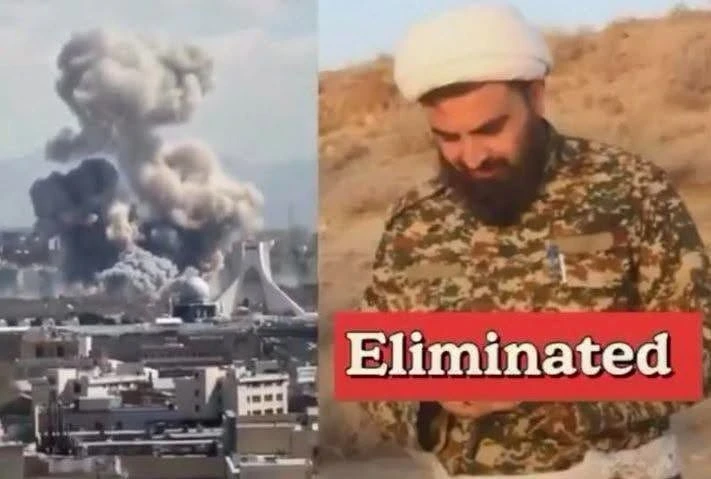
Breaking News: Claims of Tehran Strike Raise Questions Over Fate of Basij Commander TEHRAN — A reported strike in Tehran has triggered a wave of speculation after unverified claims circulated online that a senior Basij commander was killed in the incident.
The reports appeared rapidly across social media, with several accounts describing the alleged target as a prominent figure connected to Iran’s Basij organization. Within minutes, the story was being shared thousands of times, accompanied by dramatic headlines and conflicting descriptions of what had happened.
However, early reports remained unclear, and independent confirmation of the commander’s reported death was not immediately available. Residents in Tehran described hearing powerful explosions or noticing unusual activity in parts of the city, although accounts varied significantly.
Videos and photographs began appearing online, but the origins and dates of some of the material could not immediately be established. As is often the case during rapidly developing military events, information became difficult to separate from speculation.
The alleged strike reportedly occurred in a heavily populated urban environment, raising immediate questions about casualties, damage to nearby buildings, and the circumstances surrounding the operation. Officials had not provided a complete account of the incident, leaving observers waiting for more reliable information.
The Basij, a paramilitary organization affiliated with Iran’s Islamic Revolutionary Guard Corps, has long played a significant role in Iranian domestic security and political life. Its commanders can occupy influential positions, making any reported attack involving a senior figure potentially significant.
If the reports were eventually confirmed, analysts would likely examine not only the identity of the alleged target but also what the incident could mean for the wider regional situation.
The possibility of a targeted strike inside Tehran would be especially sensitive because the Iranian capital is one of the country’s most important political and administrative centers. Residents, meanwhile, were dealing with a very different reality. For ordinary families, the most immediate concern was safety.
When explosions are reported in a major city, people rarely have the luxury of waiting patiently for political analysis. Parents want to know whether their children are safe. Workers want to know whether they should travel. Families attempt to contact relatives, while businesses and schools monitor official announcements.
One fictional resident described the atmosphere as tense but confused. “Everyone was looking at their phones,” the resident said. “There were so many different stories that nobody knew which information was real.” That confusion illustrates one of the greatest challenges during modern conflicts.
Information travels almost instantly, but verification takes time. A photograph from an earlier incident can be presented as new. An old video can suddenly become viral. A claim from an anonymous account can be repeated by thousands of people until it begins to look like an established fact.