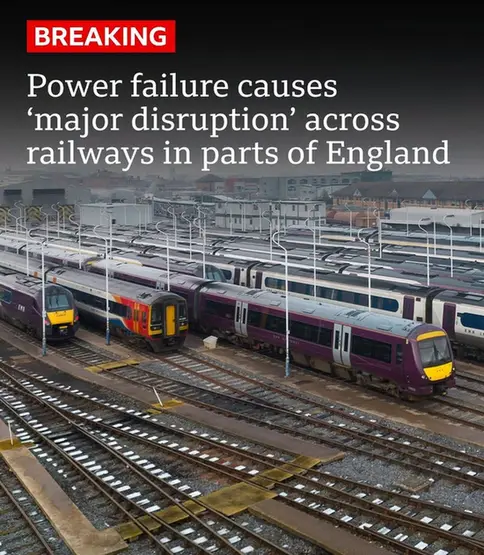
Thousands of rail passengers across the Midlands and the north of England experienced significant travel disruption after an unexpected electrical failure affected large sections of the railway network.
The incident, which occurred during one of the busiest travel periods of the day, led to widespread delays, cancellations, and reduced services, leaving commuters, tourists, and business travelers searching for alternative ways to reach their destinations.
National Rail confirmed that the disruption was caused by an electrical fault affecting infrastructure used to power railway operations. Although engineers were immediately dispatched to investigate and repair the problem, officials warned that services could remain disrupted for several hours while technicians worked to safely restore the network.
For many passengers, the morning began like any other. Commuters arrived at stations expecting routine journeys to work, students prepared to travel to universities, and families boarded trains for holidays and day trips.
However, electronic departure boards soon began displaying delayed and canceled services, while station announcements informed travelers that trains were unable to operate normally. Within minutes, platforms became crowded as passengers waited for further information.
Customer service desks experienced long queues as travelers sought advice on refunds, replacement buses, and alternative rail routes. Across major stations in Birmingham, Manchester, Leeds, Sheffield, Nottingham, Liverpool, and surrounding areas, railway staff worked continuously to assist passengers.
Loudspeaker announcements were updated frequently as engineers assessed the extent of the electrical failure. The disruption quickly spread throughout the railway network. Because Britain’s rail system is highly interconnected, delays affecting one major route often have consequences hundreds of miles away.
Trains that could not complete scheduled journeys were unavailable for later services, while train crews found themselves stranded at locations different from where they were expected to begin their next shifts.
Transportation experts often describe this as a “domino effect.” A single infrastructure problem can gradually affect dozens of routes as trains, staff, and equipment fall out of position. Passengers expressed a mixture of frustration and understanding.
“I’ve been waiting for over an hour,” one commuter said while standing at Birmingham New Street Station. “It’s disappointing, but I appreciate that safety has to come first.” Another traveler heading to Manchester explained that she missed an important business meeting after multiple services were canceled.
“I understand technical problems happen,” she said. “I just wish there had been more information earlier.” Rail operators emphasized that passenger safety remained their highest priority. Electrical systems powering modern railways are highly sophisticated, supplying energy to overhead lines, signaling equipment, communications systems, and various operational technologies.
Before services can resume following any major fault, engineers must carefully inspect damaged infrastructure to ensure it is safe. Network Rail teams were dispatched across affected areas carrying specialized diagnostic equipment.