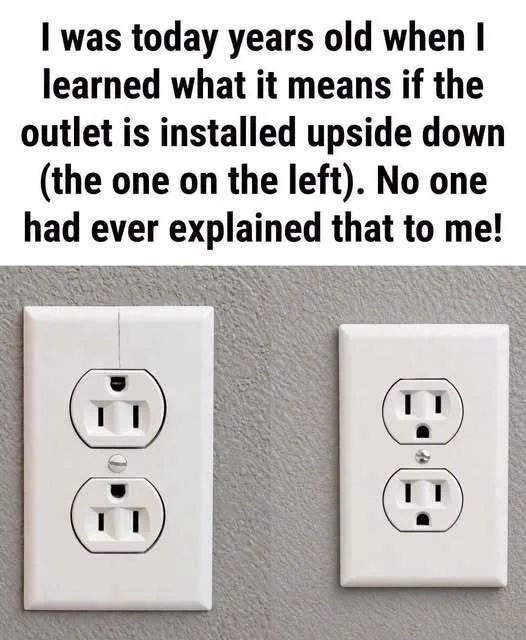
When you walk through your home and notice that a specific electrical outlet has been installed with the ground hole facing upward, your first instinct might be to assume that the electrician made a simple mistake during the installation process.
It is easy to view this orientation as an anomaly, especially when the vast majority of outlets in your living space feature the ground pin positioned at the bottom, creating a sense of visual uniformity throughout the entire house...
In reality, this specific orientation is frequently a deliberate choice rather than an error, serving as a functional indicator for the homeowner. One of the most common reasons for this configuration involves switched outlets, which were particularly popular in older residential construction before the widespread adoption of ceiling-mounted lighting fixtures.
In these setups, one half of the duplex outlet is wired to a wall switch, allowing you to control a floor lamp or table lamp with the flip of a switch, while the other half remains constantly energized for devices like clocks or chargers.
By installing the outlet with the ground hole facing up, the electrician provides a subtle, permanent visual cue that this particular receptacle functions differently than the standard, always-on outlets found elsewhere in the room.
This helps residents quickly identify which outlet is linked to the wall switch without needing to guess or experiment with every plug in the house. It is important to understand that there is no National Electrical Code (NEC) requirement that mandates a specific orientation for electrical receptacles.
Because the code remains silent on this matter, the final decision often rests entirely on the preferences of the individual electrician, the specific regional building practices, or the requirements set forth by a particular home builder.
In some areas, contractors might adopt a standard of installing all outlets with the ground hole facing up as a matter of personal preference or local tradition, regardless of whether the outlet is switched or always powered.
Consequently, you cannot assume that every upside-down outlet in your home is controlled by a wall switch, as it could simply be a stylistic choice or a reflection of the installer’s personal habit or regional customs that have persisted over many decades of residential construction.
The lack of a universal standard means that visual inspection alone is rarely sufficient to determine the true nature of an outlet’s wiring. While the upside-down orientation is a common convention for switched outlets, it is not a universal rule that you can rely on with absolute certainty.
If you are trying to determine which outlets in your home are switched, the only truly reliable method is to perform a practical test. Simply plug a lamp or a small electronic device into the outlet in question and systematically toggle the wall switches in the immediate vicinity.
If the device turns on and off in response to a switch, you have successfully identified a switched outlet.