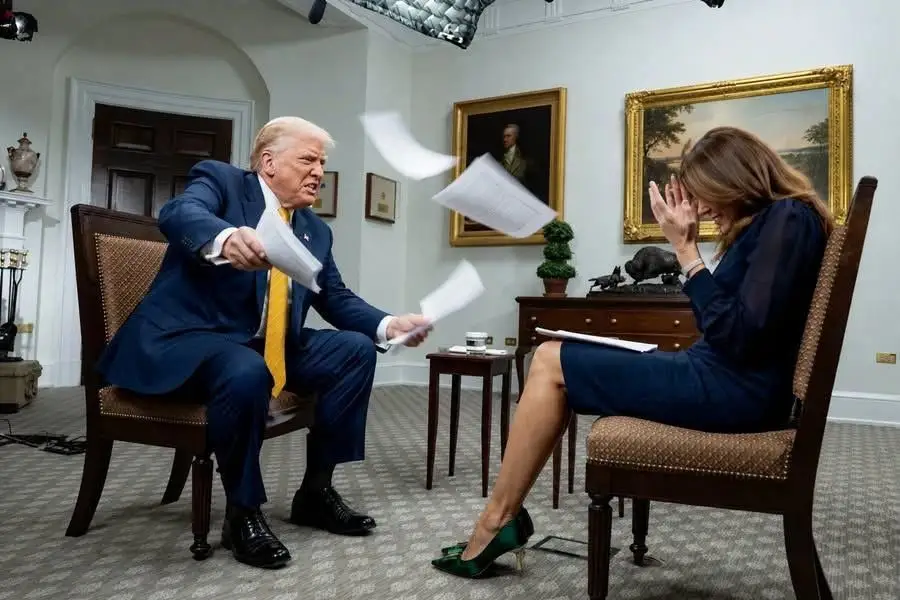
A tense confrontation between President Donald Trump and CNN correspondent Kristen Holmes has once again drawn national attention to the increasingly combative relationship between the White House and the press.
The exchange took place during an Oval Office event when Holmes asked Trump a pointed question concerning remarks made by Democratic Senator Jon Ossoff about the president and his close aide, Natalie Harp. Trump did not respond quietly.
Instead, he interrupted the reporter and criticized both her question and CNN, calling her “fake news” and “disrespectful” and telling her to be quiet. The confrontation quickly became a major subject of discussion across news organizations and social media.
But the story did not end when the exchange inside the Oval Office was over. The White House’s Rapid Response account subsequently posted criticism of Holmes online, escalating the dispute beyond the original exchange.
The posts became particularly controversial because they went beyond criticism of Holmes’s reporting and made personal references involving her family. CNN responded by defending Holmes and arguing that she was doing the job journalists are expected to do: asking difficult questions of people in positions of power.
The confrontation therefore became about more than one reporter and one president. It became part of a much larger debate about the relationship between political leaders and the press. Presidents have always faced difficult questions from journalists.
Reporters are expected to challenge officials, request explanations, and ask about controversial statements or decisions. Presidents, meanwhile, have the right to criticize coverage they believe is unfair. But the disagreement becomes more controversial when criticism turns personal. That is precisely what attracted attention to the Holmes incident.
The original question concerned Natalie Harp, a Trump aide who has recently received increased media attention. Holmes referenced Ossoff’s criticism of Trump’s priorities and asked the president for his response. Trump rejected the premise and attacked the reporter’s manner and credibility.
The exchange was captured on video, allowing viewers to watch the confrontation for themselves. That has made the incident particularly easy to share online.
Short clips can be removed from their original context, reposted with dramatic captions, and interpreted very differently depending on the political viewpoint of the person sharing them. This is where headlines can become misleading.
A headline claiming that Trump “attacked a CNN reporter after she accused him of killing...” suggests an entirely different confrontation from the one documented by credible reporting. There is no reliable evidence in the sources reviewed that Holmes accused Trump of killing someone.
The actual dispute centered on her questions about Ossoff’s remarks and Trump’s relationship with Harp. That distinction is important. Political journalism already operates in an environment filled with competing narratives. When an inaccurate phrase is added to a genuine event, readers can easily come away believing something that never happened.